
Reusable containers can move through dozens of locations, shipments, and business partners before returning to their point of origin. Without accurate tracking, it can be difficult to know how many containers are available, where they are located, or when more will be needed.
For one major food and agricultural products company, that challenge involved more than 12,000 reusable bins moving between packing operations and a third-party processing partner.
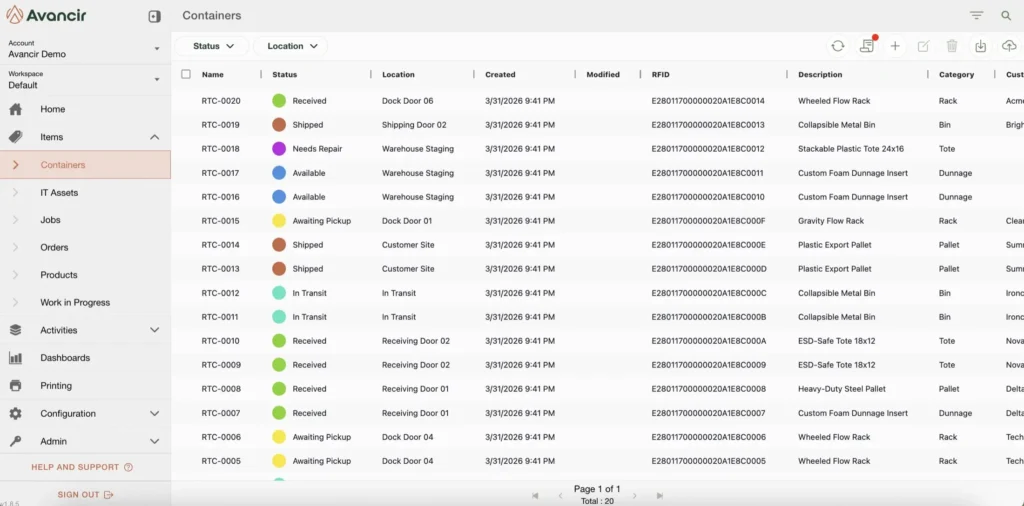
Avancir implemented an RFID-powered reusable asset tracking solution that connects physical bin movement with operational workflows and the systems already supporting the company’s supply chain.
The result is greater inventory visibility across approximately 20 sites, more streamlined shipping and receiving processes, and better information for managing and forecasting the reusable container pool.
The Challenge: Keeping Track of Thousands of Reusable Bins
Reusable bins are a critical part of the company’s daily operations, but maintaining an accurate inventory became increasingly difficult as containers moved between organizations and locations.
Manual tracking created visibility gaps that made it harder to answer basic operational questions:
- How many bins are currently available?
- Where are they located?
- Which bins have been shipped?
- Which facility or trading partner currently has them?
- How many containers will be needed in the future?
When inventory information was delayed or inaccurate, employees had to spend additional time reconciling counts and determining the true status of the reusable asset pool.
The lack of visibility could also affect shipping operations, asset accountability, and the company’s ability to forecast future container requirements.
The Solution: RFID-Powered Reusable Container Tracking
Avancir implemented an RFID solution designed around the customer’s existing supply chain workflows.
Rather than requiring employees to scan individual barcodes one at a time, RFID handheld readers allow teams to identify groups of tagged containers quickly during inventory and movement workflows.
Daily RFID scanning helps the organization maintain a more current picture of reusable assets as they move through the supply chain.
The deployment now supports approximately 20 sites and more than 12,000 reusable bins.
Connecting Container Movements to Business Events
Capturing an RFID tag is only part of the process.
The Avancir Monitoring Engine applies business logic to the RFID activity so container movements can be interpreted within the context of the customer’s actual operations.
Bin locations and inventory information can be updated based on events including:
- Inbound inventory activity
- Outbound shipments
- Trailer movements
- Shipment allocation
- Inventory transactions
This allows the system to understand not only that a container was detected, but also what operational event caused it to move.
The workflows were configured around the customer’s existing processes instead of forcing the operation into a generic asset-tracking model.
Integrating RFID With the Processing Partner’s MES
Avancir also integrates with the third-party processing partner’s Manufacturing Execution System (MES).
The integration creates a connected flow of information between RFID activity and the operational system already being used by the processing partner.
Physical container movements and system transactions can therefore contribute to the same operational view of reusable asset inventory.
To date, Avancir has captured more than 1 million transactions with the MES, demonstrating the scale of the information exchanged between the RFID tracking environment and the customer’s operational systems.
The Results: Better Visibility Across Organizations and Locations
The RFID solution provides improved visibility into reusable container inventory across participating facilities and organizations.
Instead of relying primarily on disconnected manual records, employees have access to more current information about container locations, movements, shipments, and inventory activity.
The solution helps the company:
- Maintain more accurate reusable asset inventory across locations
- Streamline shipping and receiving workflows
- Reduce manual inventory reconciliation
- Improve visibility into trailer movements and shipment allocation
- Increase accountability between trading partners
- Make more informed decisions when forecasting future container requirements
While specific percentage improvements in inventory accuracy or labor savings were not measured, RFID provides the organization with a faster and more scalable method for maintaining reusable container visibility across a complex supply chain.
From RFID Reads to Supply Chain Visibility
Reusable asset tracking becomes much more valuable when location information is connected to the operational events that explain why an asset moved and where it should be next.
Avancir provides the workflow and integration layer that connects RFID reads with shipment events, inventory transactions, trailer activity, and existing operational systems.
Rather than creating another standalone tracking database, RFID becomes part of the processes already driving the customer’s supply chain.
For organizations managing thousands of reusable bins, totes, containers, pallets, or other returnable assets, that connection can provide a clearer view of inventory across facilities and trading partners, and help teams make better decisions about where assets are today and what will be needed tomorrow.
Learn more about how Avancir powers RFID-based reusable and returnable asset visibility on our Returnable Container Tracking use case page.