
In a large manufacturing environment, knowing where a job is can be just as important as knowing what stage of production it has reached.
For one global aerospace manufacturer, that visibility was becoming increasingly difficult to maintain. Approximately 4,000 active jobs and bins move through workstations and production areas across multiple buildings. When employees had to manually update job locations and statuses, the information in production systems did not always keep pace with what was actually happening on the plant floor.
Avancir implemented a hybrid RFID solution that connects the physical movement of work-in-process directly to the manufacturer’s production systems.
The result: greater visibility into WIP, fewer manual status updates, and a scalable RFID platform the manufacturer is now expanding to additional use cases.
The Challenge: Tracking WIP Across Multiple Buildings
The manufacturer uses plastic bins to carry parts associated with individual production jobs.
As those bins moved between workstations and buildings, employees relied heavily on manual processes to keep job locations and production statuses current.
That created several challenges.
Employees could not always immediately determine where a job was, whether it had reached the correct next production step, or whether the status in the ERP accurately reflected its physical location.
When the physical job and digital record did not match, employees had to spend additional time searching for materials, reconciling information, and determining the true status of production.
With roughly 4,000 active jobs or bins in the system, the manufacturer needed a more automated way to connect plant-floor activity with its production data.
The Solution: A Hybrid RFID Tracking System
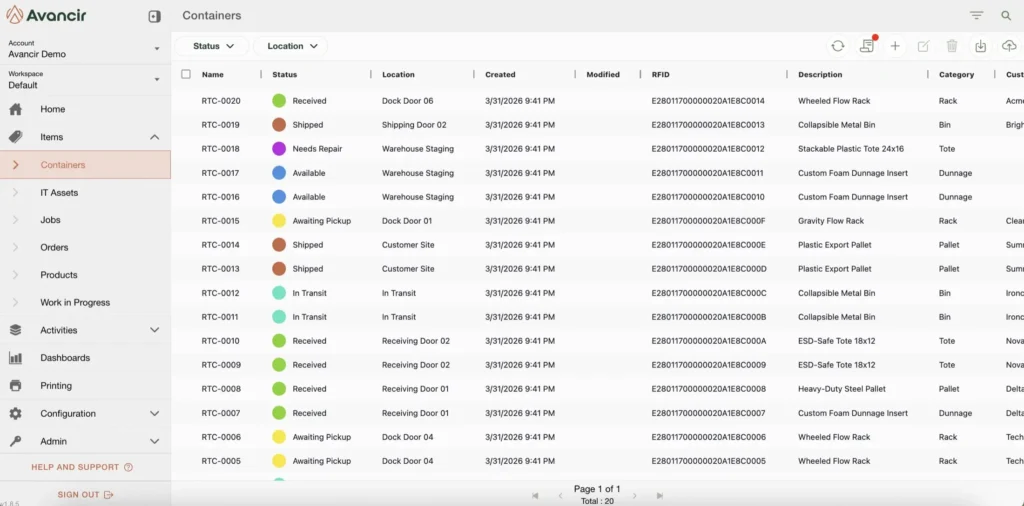
Avancir designed a hybrid RFID solution that automatically captures job movement throughout the manufacturing process.
The deployment combines:
- 15 fixed RFID read zones
- RFID handheld readers
- RFID printer/encoders
- RFID-tagged job bins
- The Avancir Monitoring Engine
- Integration with the manufacturer’s JobBoss ERP
Fixed RFID infrastructure automates movement capture in high-traffic areas, while mobile RFID devices support workflows where permanent read zones are not practical.
This hybrid approach gives the manufacturer automation where it makes sense without requiring fixed RFID infrastructure at every location.
Turning RFID Reads Into Production Events
Capturing an RFID tag read is only the first step.
The Avancir Monitoring Engine continuously evaluates RFID activity and determines what each movement means within the manufacturer’s production workflow.
When a tagged bin moves between designated areas, Avancir can automatically:
- Update the job’s location
- Change its production status
- Confirm movement between workstations
- Identify workflow exceptions
- Trigger alerts when a job deviates from its expected process
Instead of requiring an employee to record every movement manually, the movement of the physical job can create the appropriate digital event automatically.
Connecting RFID With JobBoss ERP
The solution also integrates directly with the manufacturer’s JobBoss ERP.
Job information from JobBoss can be used to create and encode RFID labels, while RFID activity captured on the plant floor can update the production systems employees already use.
Approximately 4,000 individual JobBoss job records are currently associated with the RFID workflow. Because each job can move and be updated numerous times during production, the total number of RFID-driven transactions is significantly higher.
This creates a connected workflow in which the digital job record initiates RFID tracking and subsequent physical movement can drive changes to job location and status.
The Results: Real-Time Visibility With Less Manual Updating
The RFID system now provides real-time visibility into work-in-process as jobs move across the manufacturer’s production environment.
Employees can more quickly determine where a job is located and whether it has progressed to the expected stage of production.
The manufacturer has also reduced its reliance on manual status updates. Once a new job is created and its RFID label is printed through Avancir, many subsequent location and status changes can occur automatically as the job moves through the facility.
The solution helps the manufacturer:
- Find work-in-process faster
- Keep job locations and statuses more accurate
- Reduce manual production updates
- Identify misplaced or delayed jobs sooner
- Detect workflow exceptions
- Keep physical production activity aligned with ERP records
Rather than operating as another standalone tracking system, RFID becomes part of the manufacturer’s existing production workflow.
Expanding RFID Beyond Work-in-Process
The WIP deployment has also created a foundation for additional RFID applications.
The manufacturer is now using the Avancir platform to track approximately 500 high-value tools using workflows designed specifically for tooling rather than production jobs.
Plans are also underway to add RFID hardware and additional tracking locations in a fourth building on the manufacturer’s campus.
That expansion demonstrates one of the advantages of building RFID around a configurable software platform: the same underlying infrastructure can support multiple asset types, workflows, and business processes.
From RFID Data to Actionable Workflows
The value of RFID in manufacturing extends beyond knowing that a tag passed a reader.
Avancir helps determine which job moved, where it moved, whether that movement was expected, and what should happen next.
By connecting RFID activity with production logic and ERP systems, manufacturers can move away from manually maintaining WIP information and toward workflows where physical activity updates digital systems automatically.
For manufacturers struggling to locate work-in-process or keep production statuses synchronized with what is actually happening on the floor, that connection can turn RFID from a tracking technology into an operational automation tool.
Learn more about how Avancir powers real-time WIP tracking and automated manufacturing workflows on our Work-in-Progress Tracking use case page.