

Choosing the right RFID tag for inventory management comes down to four things: what you’re tagging, what it’s made of, where it will live, and how far away you need to read it. For most teams, the best tag is not the cheapest option or the most rugged one on the shelf. It’s the tag that reads consistently in the real workflow you’re trying to automate. Here’s a simple way to narrow your options fast, including when passive RFID tags make sense, when UHF is the best fit, and which tag formats usually work best for common inventory scenarios.
What Makes an RFID Tag “Right” for Inventory Management?
The “right” tag is one that’s readable, durable enough for the job, compatible with the item surface, and priced in line with the value of the inventory you’re tracking. That answer changes depending on whether your goal is faster cycle counts, item-level visibility, pallet tracking, location awareness, or loss prevention. Tag choice affects read accuracy, speed, and how reliable your RFID inventory tracking system feels day to day. That’s really the core of how to choose the right RFID tag for inventory management: match the tag to the workflow, not to a generic spec sheet.
Start With These 4 RFID Tag Selection Factors
1. Item Type
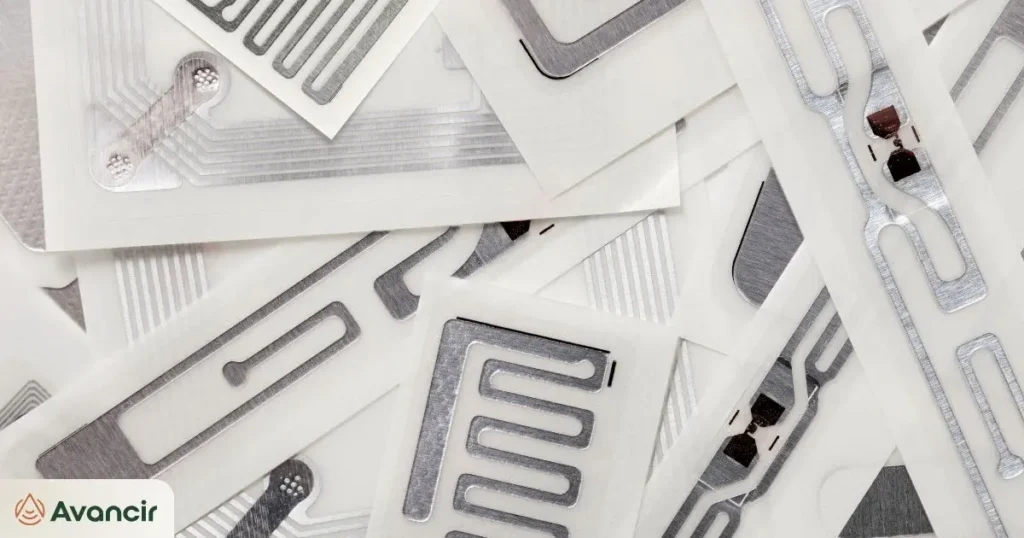
Start with tag format. Small retail items often use RFID labels or hang tags. Cartons usually use printable labels. Pallets, reusable bins, and returnable containers often need a tougher hard tag. Tools, racks, and fixed assets may need a mount-on tag that can handle rough handling. Disposable items and reusable assets rarely use the same tag format, even inside the same facility.
2. Material / Surface
Surface type has a huge impact on performance. Cardboard and many plastics are friendly to standard passive UHF labels. Metal and liquid are not. Standard tags often lose performance near steel shelving, metal tools, liquid containers, and electronics, which is why rfid tags for inventory management on metal surfaces usually need purpose-built on-metal designs. AtlasRFIDstore’s metal-mount guidance makes that point directly: metal can detune passive tags that aren’t designed for metal placement.
3. Environment
Next, look at the environment. A clean retail stockroom has very different requirements than a warehouse yard, washdown area, or production floor. Heat, moisture, abrasion, chemicals, UV exposure, and repeated impacts all influence whether you need a simple adhesive label or a more encapsulated, durable option. The tag itself may be fine electrically, but fail because the adhesive, face stock, or attachment method doesn’t match the environment.
4. Read Range
Read range should be defined by workflow, not by the maximum number in a product listing. Handheld cycle counting, shelf reads, dock-door reads, and room-level visibility are different use cases. If your team is scanning cases up close with handhelds, you may not need an ultra-rugged long-range tag. If you’re reading pallets through portals at receiving, you need a tag and reader setup that performs reliably in motion and at distance. That’s the practical lens for any rfid inventory tracking system.
Passive vs Active RFID Tags: Which Should You Use?
For most inventory programs, passive RFID tags are the default choice. They don’t have a battery, they cost less, and they scale much better for item-, carton-, and pallet-level tracking. Active tags use a battery and support longer-range visibility, but they come with a much higher per-tag cost and are usually reserved for specialized real-time tracking of high-value assets, vehicles, or equipment. In other words, the best passive RFID tags for inventory tracking are usually the best starting point unless your use case truly depends on beacon-like visibility or unusually long read distances.
A simple rule works well here:
- Passive = lower cost, easier to scale, common for retail items, cartons, cases, pallets, and general inventory
- Active = longer range, higher cost, better for specialized, high-value asset scenarios
Most all Avancir-specific use cases and technology fall under the Passive category.
When UHF Is the Best Choice for Inventory
In most inventory environments, UHF RFID tags are the best fit because they support fast reads and are widely used for item-, case-, and pallet-level tracking. GS1 specifically notes that RAIN RFID can improve supply chain visibility and inventory accuracy, and RAIN RFID is passive UHF technology. HF can still make sense for short-range or niche workflows, but in the practical UHF vs HF RFID tags for inventory management debate, UHF is usually the better choice for warehouses, receiving, portal reads, and handheld cycle counts.
Quick RFID Tag Recommendations by Use Case
| Inventory type | Recommended tag format | Notes |
|---|---|---|
| Cartons and cases | Passive UHF printable RFID labels | Best for high-volume disposable packaging and faster counts |
| Pallets | Durable labels or hard tags | Use hard tags when pallets are reused repeatedly |
| Retail items / apparel | Small labels or hang tags | Keeps tagging low-profile and cost-effective |
| Metal assets / tools / racks | On-metal RFID tags | Standard labels often underperform on metal |
| Reusable bins / totes | Durable hard tags | Better for abrasion, impacts, and repeated handling |
| Mixed warehouse inventory | Passive UHF selected by surface and handling | Start with item type and material, then test in workflow |
For general inventory management, a few current options stand out:
Printable labels for cartons and mixed non-metal items: Vulcan RFID Bolt UHF RFID Label | M830 and Vulcan RFID Flame UHF RFID Label | M830 are both strong printable passive UHF options for non-metal inventory. Both are designed for surfaces like cardboard and plastic, with the main difference being size and performance. The larger Bolt offers more read performance, while the smaller Flame is a better fit when space is tighter.
Reusable bins, totes, and mobile non-metal assets: Vulcan RFID Custom Flex Hard Tag is a solid option for rugged reusable assets. The Beontag Carrier Tough Slim RFID Tag | M780 is another good choice for non-metal reusable items, especially when a more permanent attachment method like rivets or screws is preferred. If the tote or bin is metal, an on-metal tag is usually the better fit.
Metal tools, racks, and equipment: The Zebra Silverline Blade II RFID Tag by Beontag | M730 and Vulcan RFID Flash On-Metal Label | NXP UCODE 8 are both strong adhesive options for metal assets. For smaller metal items, the Zebra Silverline Micro II RFID Tag by Beontag | Monza R6-P is a practical add for tighter applications. If a riveted or epoxy-style attachment is needed instead of adhesive, a different metal-mount tag would be the better choice.
If your environment includes curved or irregular metallic surfaces, Xerafy Metal Skin Delta RFID Label | M830 is another practical option. This tag option is specifically for metallic and non-metallic assets like laptops, monitors, and machinery.
3 Mistakes to Avoid When Choosing RFID Tags
The first mistake is choosing by price alone. Cheap tags that fail in the field are expensive once you account for missed reads, retagging, and lost labor. The second is ignoring metal, liquids, and environmental conditions until late in the process. The third is selecting a tag before defining read distance and workflow. A short pilot on the actual item, in the actual environment, usually prevents the most expensive RFID tag selection errors. GS1’s Tagged-Item Performance Protocol exists for exactly this reason: performance has to be evaluated on the tagged item, not just the inlay alone.
Build an RFID Inventory Management Solution with Avancir
Most inventory programs can simplify RFID tag selection by working through four questions: What is the item? What surface is it made of? What environment will it face? How far away do you need to read it? In a lot of cases, the answer starts with passive UHF and gets narrower from there. For help matching tags, readers, and software to your environment, reach out to Avancir for expert support on building the right RFID inventory management solution. If you’re ready to create your own Inventory Management Solution using RFID, start your free trial with Avancir today and see what that looks like for your business operations.
FAQ
Are passive or active RFID tags better for inventory management?
Passive is better for most inventory applications because it’s far more affordable to scale across items, cartons, and pallets. Active is usually reserved for specialized long-range tracking.
Does RFID work on metal surfaces?
Yes, but standard tags may not work well there. On-metal tags are typically needed because metal can detune ordinary passive tags.
Are RFID labels enough for warehouse inventory?
Often, yes. RFID labels are commonly used for cartons, cases, and many retail items. Rugged reusable assets may need hard tags instead.
Is UHF or HF better for inventory management?
UHF is usually better for broader inventory tracking because it supports fast reading across item, case, and pallet workflows. HF is more niche and usually makes more sense for shorter-range use cases.
What type of RFID tag is best for warehouse inventory?
Usually passive UHF, but the best format still depends on item type, surface, environment, and read distance. A warehouse with cardboard cases needs something different from one tracking steel tools or reusable totes.